Table of Contents
- Why It Matters: Volcanoes, Earthquakes & Climate
- Mount Tambora
- Major Historic Eruptions & Volcanoes on the Ring
- 1.Mount Tambora (Indonesia, 1815)
- 2.Krakatoa (Indonesia, 1883)
- 3. Novarupta (Alaska, 1912)
- 4. Mount Saint Helens (USA, 1980)
- 5. Mount Pinatubo (Philippines, 1991)
- 6. Mount Ruapehu (New Zealand)
- 7. Mount Pinatubo & Taal Volcano (Philippines)
- 8. Klyuchevskoy & Kamchatka Volcanoes (Russia)
- 9. Others: Mount Awu (Indonesia)
- Major Regions of the Ring & Top Volcanoes
- Looking Ahead: What Science Tells Us
- Summary Table of Key Volcanoes & Historic Eruptions
- Why This Topic Matters to You
- Quick Facts About the Ring of Fire
- Types of Eruptions Along the Ring of Fire
- How Scientists Predict Volcanic Eruptions
- Historical Lessons from Major Eruptions
- Most Dangerous Volcanoes Today (2025)
- United States (Alaska + Pacific Northwest)
- conclusion
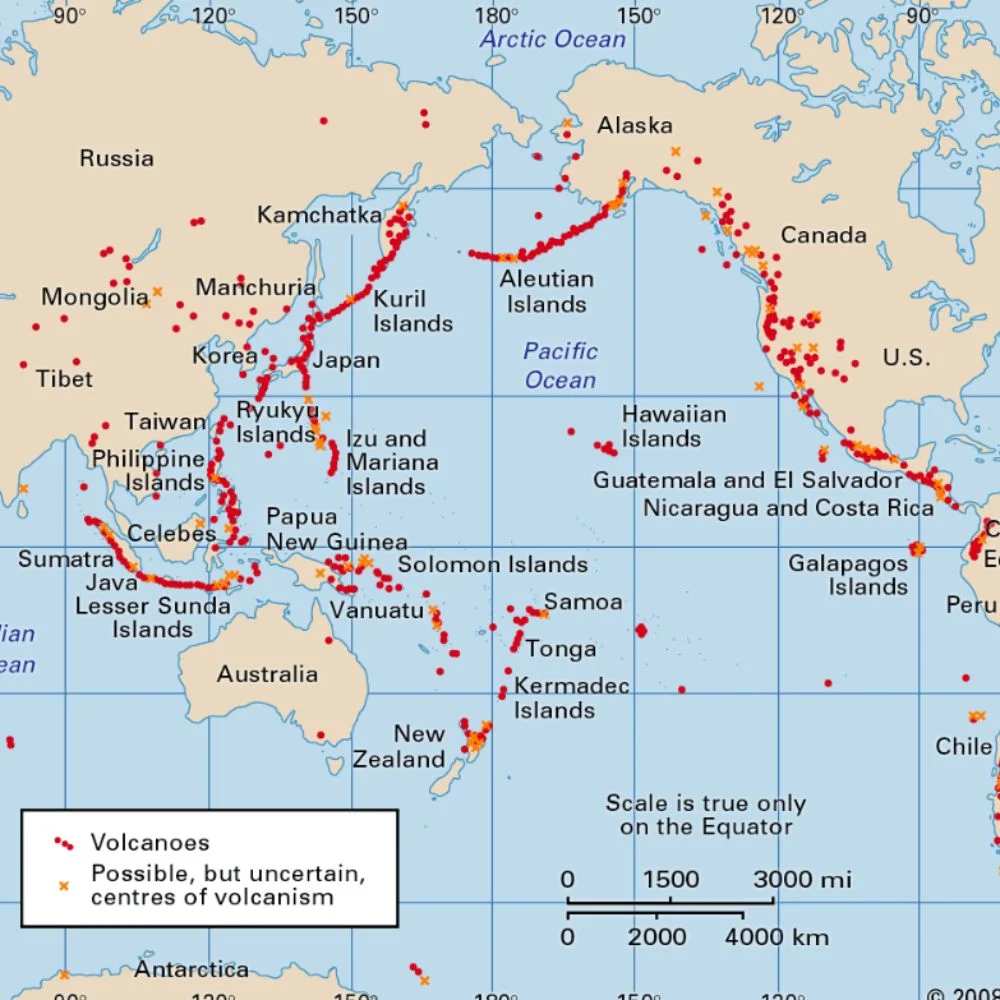
The “Ring of Fire” is a vast chain of volcanoes and fault zones around the Pacific Ocean. More than 75% of Earth’s active volcanoes lie there, plus about 90% of its largest earthquakes. It formed as several tectonic plates, like the Pacific, Nazca, Cocos, Juan de Fuca, and Philippine plates, slide under or along continental plates. This motion creates deep-sea trenches, volcanic arcs, islands, and mountain belts around the Pacific rim.
Why It Matters: Volcanoes, Earthquakes & Climate
The Ring of Fire shapes landscapes, causes disasters, and even changes global weather. Scientists count over 350 volcanoes there that have erupted in historical times. Since 1800, volcanoes in this zone have been behind a large share of all global eruptions.
Mount Tambora
Large volcanic eruptions can drop global temperatures, trigger famines, and damage crops. The famous eruption of Mount Tambora in 1815, in Indonesia, led to the “year without a summer” in 1816 with cold and crop failures in Europe and North America.
Major Historic Eruptions & Volcanoes on the Ring
1.Mount Tambora (Indonesia, 1815)
This is the largest recorded eruption of the Holocene (last 10,000 years). On Sumbawa Island, Tambora blew roughly 37–45 km³ of material (VEI 7). It killed around 10,000 people directly, and up to 90,000 died afterward due to famine and disease. The eruption dropped global temperatures, causing extreme weather worldwide in 1816.
2.Krakatoa (Indonesia, 1883)
The eruption destroyed over 70% of Krakatoa Island. The big blast on 27 August was VEI 6. It caused tsunamis that killed between 36,000 and 120,000 people. The sound was heard thousands of kilometers away, and the pressure wave circled the globe multiple times.
3. Novarupta (Alaska, 1912)
This Alaska volcano produced one of the largest eruptions of the 20th century. Though not as well known as Tambora or Krakatoa, it created the Valley of Ten Thousand Smokes and had major ash fallout.
4. Mount Saint Helens (USA, 1980)
On 18 May 1980, Washington State’s Mount St. Helens blew its north side off in a cataclysmic eruption. It was preceded by thousands of tremors, a bulge on the volcano, and then a massive landslide and explosion. About 57 people died, and the eruption flattened 230 square miles of forest.
5. Mount Pinatubo (Philippines, 1991)
This eruption reached VEI 6, lofted sulfur into the stratosphere, and cooled the Earth by up to 0.5°C for over a year. It caused widespread ash damage, displaced tens of thousands, and affected the global climate.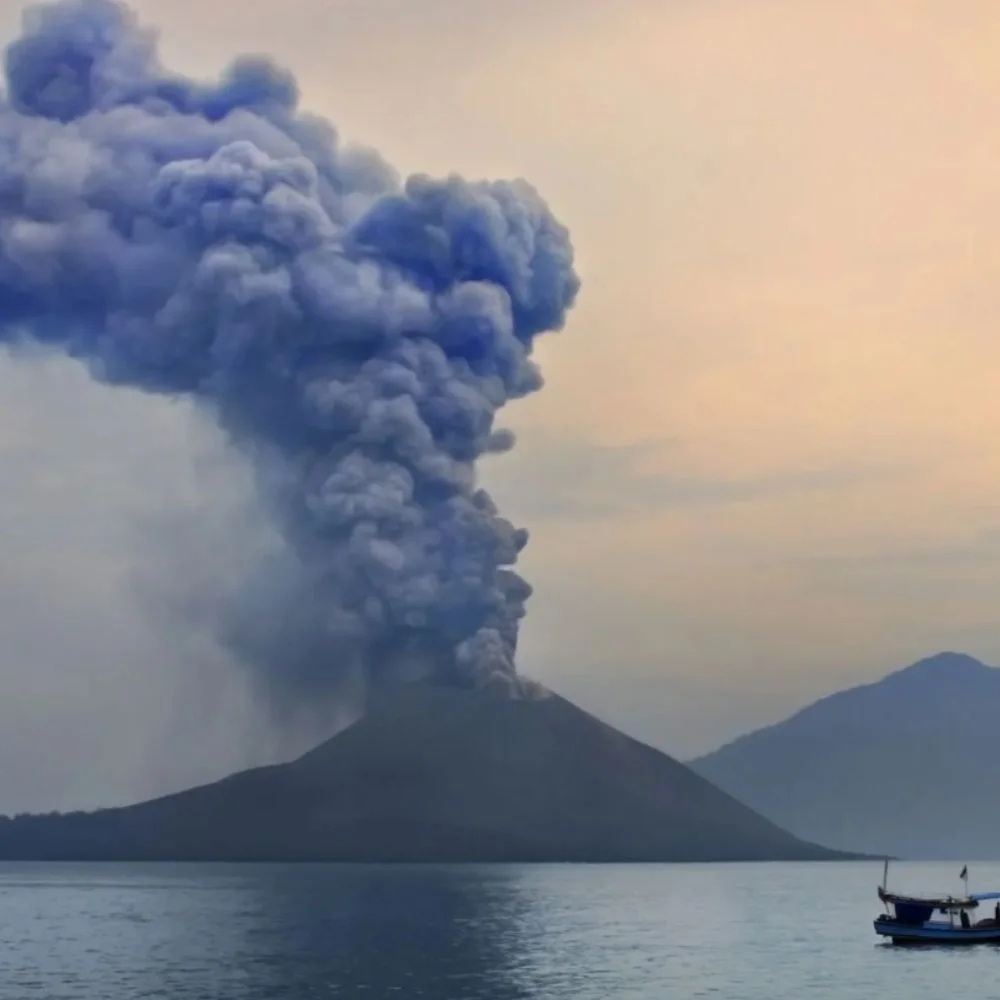
6. Mount Ruapehu (New Zealand)
An active cone in the Taupo Volcanic Arc, Ruapehu, often erupts. The last major eruption was in 1996, and experts monitor its crater lake closely for lahars (mudflows), especially during November–March.
7. Mount Pinatubo & Taal Volcano (Philippines)
Taal has erupted more than 30 times, with major events in 1754, 1911, and 1965. The 1754 eruption lasted about seven months and buried towns under ash and volcanic debris. Taal lies in a lake, making eruptions more explosive and ash more dangerous for health.
8. Klyuchevskoy & Kamchatka Volcanoes (Russia)
The Kamchatka Peninsula holds over 300 volcanoes. Klyuchevskoy, Asia’s tallest volcano, erupted from June to December 2023, producing lava flows and ash plumes reaching 7.5 miles high. The eruption lasted into April 2025 and disrupted air traffic.
9. Others: Mount Awu (Indonesia)
Awu has erupted frequently since the 1600s. Major eruptions in 1812 and 1966 were VEI 4 and caused pyroclastic flows and lahars that killed over 11,000 people. A crater lake and rainfall make it a dangerous volcano in the Sangihe Islands.
Major Regions of the Ring & Top Volcanoes
1. Alaska & Aleutians
Part of the northern arc where the Pacific Plate sinks beneath the North American Plate, it contains Novarupta, Redoubt, Shishaldin, and others.
2. Cascades (North America)
Stretching from Washington to California, this belt includes Mount St. Helens, Mount Rainier, Mount Hood, and Mount Shasta.
3. Mexico & Central America
The Trans Mexican Volcanic Belt holds Popocatépetl, Colima, and many others built by subduction of the Cocos Plate under the North American Plate.
4. Andes (South America)
The Nazca Plate subducts under South America. Its volcanoes include Ojos del Salado, Llullaillaco, Cotopaxi, and others along the Andean volcanic zones.
5.Kamchatka & Kurils (Russia)
This region is one of the most volcanically active. Famous for its powerful eruptions and frequent lava flows, it contains more than 300 volcanoes, including Bezymianny and Tolbachik.
6. Indonesia & Philippines
Home to Tambora, Krakatoa, Taal, Pinatubo, Merapi, Kelud, Dieng, and more. Subduction of the Australian and Philippine Plates creates intense eruptive activity.
7. Japan & Taiwan
Mount Fuji last erupted in 1707. Japanese volcanoes are fed by multiple plates intersecting at triple junctions. Eruptions tend to be explosive.
Looking Ahead: What Science Tells Us
Volcanoes on the Ring of Fire remain highly active, with about 1,531 confirmed eruptions since 1960 alone, about 68% of the global total. Scientists monitor volcanoes using seismic, geochemical, and ground deformation data to detect impending eruptions and protect people.
Tree ring studies and remote sensing (like on Mt. Etna) help detect precursors to eruption. Changes in vegetation or gas levels may warn of magma movement beneath the ground.
Summary Table of Key Volcanoes & Historic Eruptions
| Volcano | Location | Historic Eruption | VEI | Impact |
| Tambora | Indonesia | 1815 | 7 | ~90,000 deaths, global “year without summer” |
| Krakatoa | Indonesia | 1883 | 6 | Island collapse, huge tsunamis, global shock |
| Novarupta | Alaska, USA | 1912 | ~6 | Massive ash flows, valley creation |
| St. Helens | Washington, USA | 1980 | ~5 | 57 deaths, landscape flattened |
| Pinatubo | Philippines | 1991 | 6 | Global cooling, ashfall, mass evacuations |
| Taal | Philippines | 1754, 1911, 1965 | 4–5 | Town burial, lake eruption risks |
| Ruapehu | New Zealand | Multiple; 1996 | ~3–4 | Lahars, crater lake hazards |
| Klyuchevskoy | Russia (Kamchatka) | 2023–25 ongoing | 3–4 | Lava horns, ash plumes, and air traffic effects |
| Awu | Indonesia (Sangihe) | 1812, 1966 | ~4 | Lahars, pyroclastic flows, >11,000 deaths |
Why This Topic Matters to You
Understanding the Ring of Fire helps explain why earthquakes, tsunamis, and volcanic eruptions often occur near coasts. It shows how geology shapes human life and climate. Even everyday weather can be influenced by a volcano’s ash cloud.
For anyone interested in travel, safety planning, earth science education, or the history of disasters, studying this belt gives insight into how Earth works and how humans adapt.
Quick Facts About the Ring of Fire
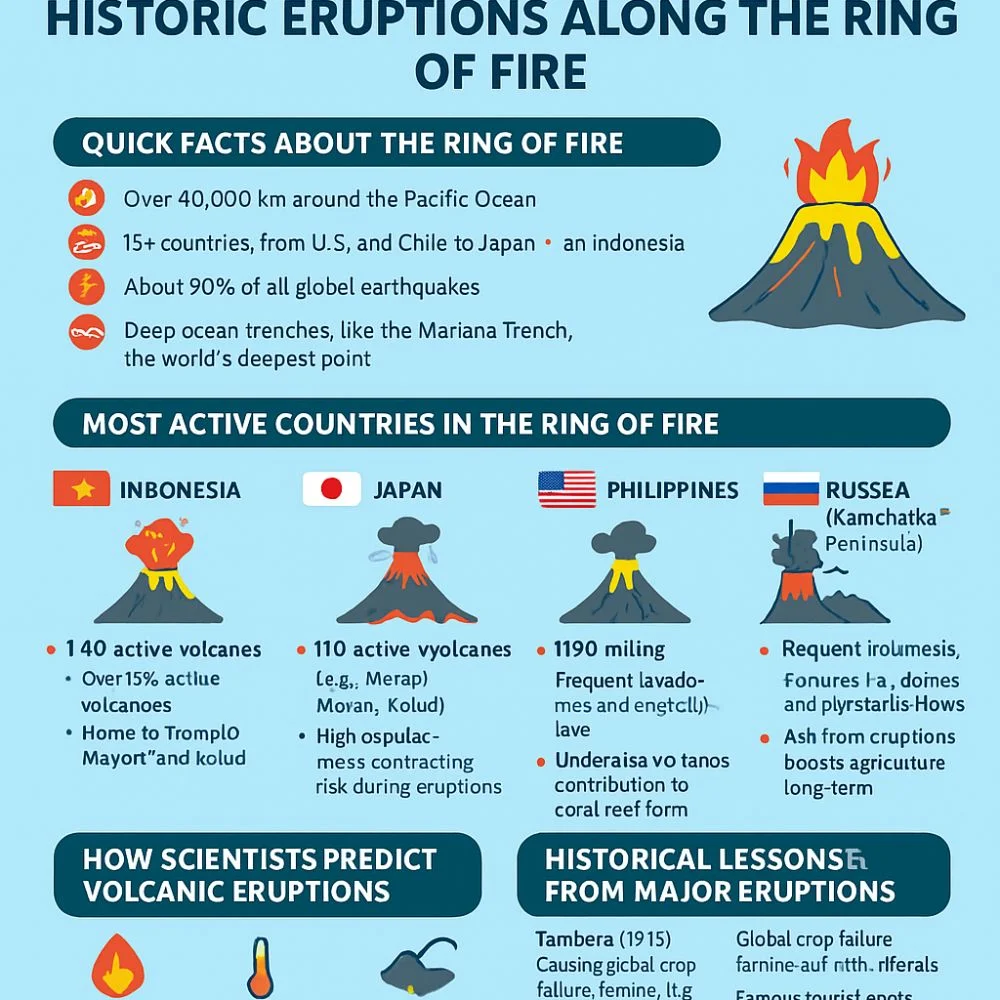
- Covers over 40,000 kilometers: around the Pacific Ocean.
- Includes 15+ countries, from the U.S. and Chile to Japan and Indonesia.
- Holds around 75% of the world’s active volcanoes.
- Responsible for about 90% of all global earthquakes.
- Includes deep ocean trenches, like the Mariana Trench, the world’s deepest point.
Types of Eruptions Along the Ring of Fire
- Explosive eruptions: High gas content and viscous lava (e.g., Pinatubo).
- Effusive eruptions: Steady lava flow, less explosive (e.g., Kilauea).
- Phreatomagmatic eruptions: Caused by magma interacting with water (e.g., Taal).
How Scientists Predict Volcanic Eruptions
- Seismographs: detect tremors caused by moving magma.
- Gas sensors: monitor sulfur dioxide levels.
- Thermal imaging: identifies heat changes near the crater.
- GPS technology: tracks ground deformation before eruptions.
- Drones and satellites help view hard-to-reach or dangerous volcanoes.
Historical Lessons from Major Eruptions
- Tambora (1815): Global crop failure, famine, “Year Without a Summer.”
- Krakatoa (1883): Triggered massive tsunamis and climate effects.
- Pinatubo (1991): Largest eruption in modern times with a global temperature drop.
- Mount St. Helens (1980): Showed the value of early warning signs like tremors and bulging.
Most Dangerous Volcanoes Today (2025)
Here are currently high-risk volcanoes under watch in the Ring of Fire:
- Merapi (Indonesia): Frequent lava domes and pyroclastic flows.
- Popocatépetl (Mexico): Near large populations; active since 1994.
- Sakurajima (Japan): Regular ash explosions; closely watched.
- Taal (Philippines): Reactivated in 2020; ash hazard to Manila.
- Klyuchevskoy (Russia): Recent eruptions in 2023–25; ongoing monitoring.
United States (Alaska + Pacific Northwest)
Alaska has over 130 volcanoes, many still active.
- Mount St. Helens (1980) was the most deadly eruption in U.S. history.
- Includes the Cascadia Subduction Zone, a major seismic threat.
1. Russia (Kamchatka Peninsula)
- The region includes Klyuchevskoy, Bezymianny, and Sheveluch.
- Known for frequent eruptions, many affecting international flights.
- One of the least populated yet most volcanic regions.
conclusion
The Pacific Ring of Fire is Earth’s most active volcanic and earthquake belt. From Tambora’s global climate effects to St. Helens’ explosion, these volcanoes have shaped history and still impact our present and future. By learning about them in plain terms, readers can better appreciate our planet’s power and the importance of monitoring, preparedness, and respect for nature’s forces.