
Table of Contents
When you have a “recessed maxilla,” your upper jaw is set too far back. This makes your face look flattened in the middle and can cause functional issues like breathing trouble, misaligned teeth, speech problems, and even sleep apnea.
What Causes a Recessed Maxilla?
1. Genetics & Developmental Conditions
Some people are simply born with an underdeveloped jaw, often because of family traits or genetic conditions like Angelman syndrome, fetal alcohol syndrome, cleft lip/palate, or Crouzon syndrome.
2. Childhood Habits & Environment
Prolonged thumb-sucking, tongue thrusting, mouth breathing due to allergies, and poor posture during development can push the upper jaw backward.
3. Trauma & Illness
Accidental jaw injuries or surgeries when young can halt normal maxilla growth.
Signs You Might Have It
- A flat midface or cheekbones appear less prominent
- Overbite or crowded teeth
- Speech difficulty or subtle lisp
- Trouble breathing, snoring, or mouth breathing
- TMJ pain, tension, headaches, or sleep apnea symptoms.
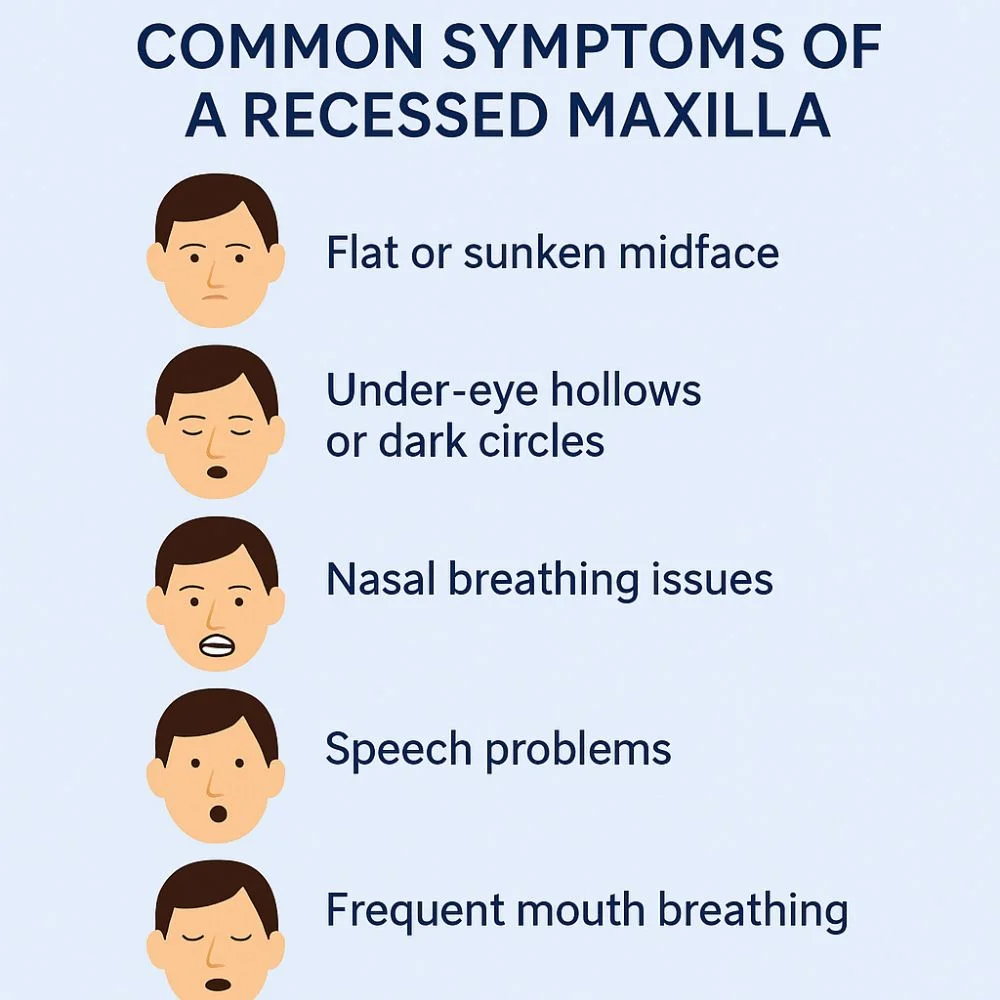
Common Symptoms of a Recessed Maxilla
1. Flat or sunken midface
The area under the eyes looks flat or underdeveloped, giving the face a less defined appearance.
2. Under-eye hollows or dark circles
Because the upper jaw isn’t forward enough, it can create shadowing or puffiness under the eyes.
3. Nasal breathing issues
A recessed maxilla can narrow the nasal passage, leading to chronic mouth breathing or nasal congestion.
4. Overbite or crowded teeth
The upper jaw doesn’t support the teeth well, causing bite misalignment or tight spacing.
5. Speech problems
Difficulty with certain sounds or a slight lisp due to poor tongue placement and jaw positioning.
6. Frequent mouth breathing
Due to narrowed airways or nasal issues, you may find yourself breathing through your mouth, especially during sleep.
7. Snoring or mild sleep apnea
Airway obstruction can lead to noisy breathing, restless sleep, or even mild sleep apnea.
8. TMJ pain or jaw discomfort
Misalignment may put extra stress on the jaw joint, causing headaches, jaw clicking, or discomfort.
9. Lack of facial balance
The face may appear longer, less projected, or out of balance when viewed from the side.
10. Delayed or abnormal jaw growth in children
If spotted early, symptoms like a weak bite or sunken midface can be signs of maxillary underdevelopment.
How Is It Diagnosed?
Dentists and orthodontists look at your face, examine your bite, and often use X-rays, cephalometric scans, or 3D imaging to measure jaw positions.
Treatment Options: From Mild to Major
1. Non-Surgical Options (Best Early or Mild Cases)
Mewing & Myofunctional Exercises
- Proper tongue posture (pressing toward the palate) may help palate expansion and improve facial posture over time.
- Be consistent; results are gradual and small.
Palatal Expanders
- Used mostly in children/adolescents to widen the upper jaw, improve airway, and make space for teeth alignment.
Braces or Clear Aligners
- Correct dental alignment and mild jaw discrepancies. Alone, they don’t fix jaw shape but help bite function.
Orthodontic Functional Appliances
- Devices like the Bionator guide jaw growth in growing kids, helping both jaws align.
Fillers or Chin/Maxilla Augmentation
- Dermal fillers, fat grafting, or implants can temporarily add volume for cosmetic balance with no structural jaw changes.
2. Surgical Solutions (For Severe Cases or Adults)
Le Fort I Osteotomy
- A maxilla-cutting surgery to move the upper jaw forward, aligning the bite and improving facial aesthetics, is often paired with jaw surgery.
Orthognathic Surgery
- Combined upper/lower jaw surgery, often following orthodontic prep, to correct bite and airway issues. Healing can take months.
Maxillomandibular Advancement (MMA)
- Moves both jaws forward, addressing major jaw misalignment and sleep apnea.
Age & Timing Matter
- Early (childhood/adolescence): Most effective time bones are still growing. Non-surgical tools (expanders, functional devices, mewing) can reshape the jaw more easily.
- Adults: Bone growth is complete, so surgical methods are often needed. Non-surgical options only support aesthetics or mild bite changes.
Making Your Best Choice
- Talk to an expert: An orthodontist or maxillofacial surgeon can assess with imaging and check airway, jaw alignment, and facial structure.
- Plans build step-by-step: early phases often involve braces and expanders, followed by surgery if needed.
- Consider goals:
- Bite improvement → braces, aligners, functional devices.
- Facial balance → fillers, implants, or surgery.
- Breathing/sleep apnea → expanders or jaw surgery.
- Realistic expectations & patience: Non-surgical fixes are gradual; surgeries involve recovery and some risks like swelling, nerve changes, or relapse.
FAQs
Q1. Can mewing fix it alone?
Mewing may improve posture and mild misalignments, but it cannot change bone structure; it is best for early intervention or supportive use.
Q2. Are braces enough for adults?
Braces align teeth but don’t move jawbones. For major recessed maxilla in adults, surgery is typically required.
Q3. Is surgery safe?
Yes, when done by experienced teams. Recoveries can take weeks, with full healing in months. Risks include infection, swelling, or minor nerve changes.
Q4. Will fixing the jaw improve breathing?
Yes, advancing the maxilla can open airways and reduce snoring or sleep apnea. If you’re worried about how your jaw affects your smile, speech, breathing, or confidence, start with an orthodontic consultation. Early action means easier correction and better long-term outcomes.
Conclusion
A recessed maxilla means your upper jaw hasn’t grown forward enough, and it affects both how you look and function. Early checks and simple tools help mild cases. More severe issues in adults often require surgery. Aligning jaw, teeth, speech, and breathing is possible, with the right guidance and treatment plan.